Saturday morning we had a dress rehearsal in the church where we were performing Sunday. Unfortunately it was a good distance away from the closest S-Bahn station so we had to walk for 15 minutes or so to get there. It wasn't so bad for me but I imagine it really sucked for the cellos. When we got to the church, the door was locked so we had to stand around outside and wait for a while before someone was woken up to let us in. The church itself was very nice, old building but modern stained glass.
After rehearsal a small group of us went to Checkpoint Charlie and to check out one of the remaining sections of Wall. The
well-signed at all but we found it. All the graffiti had been chipped off (probably sold to tourists like me) but it was still cool to see what it looked like. Being a civil engineer who had just taken a course in concrete, I was interested to see how heavily reinforced the wall was. Where the wall has been knocked down there are cobblestones showing where it used to be so we had fun jumping back and forth from East to
By this time, we were exhausted from carrying around our instruments all day (some people went back to the hostel to drop them off but we decided that would have taken too long and chose to lug them around instead). We walked from Checkpoint Charlie over to the area of the Konzerthaus to find somewhere to eat. None of us were all that hungry, but the only place that we could find was a fairly chic Italian place, where the waiters were visibly irritated by our ordering of two pizzas to split among the five of us.
Friday, January 19, 2007
Day 4 Saturday, Rehearsal, Checkpoint Charlie, Konzerthaus

Day 3 Friday, Rehearsal, KaDeWe, the Pergamon, and the Komische Oper
This morning we had rehearsal in the hostel again. I can’t imagine what the other hostel guests think of us. We took up almost half of the common area and blocked most of the pathways between the other half of the common area and the main lobby. A couple people sat around and listened to us for a bit, but I couldn’t tell if that was out of interest or inability to find a way through.
Afterward, the whole group went to KaDeWe, a huge department store not unlike Harrod's. We had lunch in the food halls. I had some smoked salmon, a shrimp-oil-garlic dish and strawberries and whipped cream. Then the orchestra splintered into smaller groups and went our separate ways. My group stayed at KaDeWe for a while, mostly admiring their vast chocolate selection, and then headed off to
Then the orchestra met up again at the Komische Oper to see Strauss’ comic operetta, Die Fliedermaus. The plot was so convoluted and spoken entirely in German that it was pretty indecipherable, even though I had seen an English version fairly recently. However, the set and music completely made up for that. The set fully rotated and had a three-story working elevator in the middle of the stage.
After eating dinner at an Italian place on Unter den Linden, we came back to the hostel, where we stayed up until all hours playing Apples to Apples and Spoons (with packets of something called Assugrin in place of the silverware). Despite his musical ability, I must report that Steve Miahky is pretty miserable at Spoons.
Day 2 Thursday, Berlin Philharmonic
Thursday we went to a dress rehearsal of the Berlin Philharmonic, which was pretty neat, although everyone was still really jet-lagged. They were playing a modern cello concerto and the Tschaikovky 6. Before the rehearsal, the cellist who was performing the concerto gave a half-hour talk about it, entirely in German peppered with Italian musical words. Suffice to say, it was pretty incomprehensible to most of us, although he did a few demonstrations of cello technique which were cool.
Afterward, we had some free time, so a group of trooped off toward central
After dinner at a doener kebap stand at Alexanderplatz, the group headed back to the Philharmonie. The concert was great and I was much more awake than during the rehearsal. Undoubtedly, the best part of the evening was the very zealous cymbal/gong player, who had very few notes, but made a huge production of all of them.
Day 0-1, Ithaca -> NYC -> Amsterdam -> Berlin
This was a very long day. After having rehearsals Sunday night and most of the day Monday, we left at
and modern by hostel standards. I am sharing a room with three other 2nd violinists.
It is squarely in what used to be Soviet East Berlin, and the architecture around it certainly proves that.
Some friends and I decided to use our free time this afternoon to venture into central
and changed trains at a station onto one which we thought was going into the city center. It got close. It went three or four stations, stopped for five minutes, and then went the other direction (strangely, no one else got out either). Well, no big deal, we'll just hop out and get another train going back toward the center. So we find one that comes into the station going the right direction and get on. And sit for five minutes. And then it goes the other direction. At that point we were so fed up with the indecisive trains that we decided to just bag it and came back to the hostel.
We have a rehearsal tonight (3 hours long, not exactly the best way to start the trip) with some
Monday, January 15, 2007
January 15, 2007 - Monday
From the zoo, we could see the victory tower, so we walked through parks and across highways to find it. After doing so, we took a bus to a giant department store, stopping along the way at a McDonalds because one of my friends (Mickey) insisted that getting a "Royale with cheese" (an American quarterpounder) was an experience not to be missed (and I agree!). At the Galleria, I discovered the reason we came - the bottom level was dedicated to candy and chocolate! After much excitement and empty pockets, and being tired and cold after walking in the suddenly-chilly weather, I suggested we go to the TV tower (since the new group I was with had not yet seen it), so we went, ate dinner, and relaxed. It was a fun last day in Berlin and a great way to wrap up my vacation!
Sunday, January 14, 2007
January 14, 2007 - Sunday

When I woke bright and early, a bunch of my friends asked if I wanted to see the instrument museum before our group lunch. Since there were so many places to see in our one short week, I jumped at the opportunity and we marched over to the museum. Unfortunately, we only had around half an hour to look at the exhibit, but the museum was absolutely amazing. Pianos and stringed instruments from the 17th and 18th centuries were on display, ornamented and colored with delicacy and beauty. There were violins made specifically for practicing (tiny sound-box) and stringed instruments built into walking canes! Not being much of a brass player, I couldn't fully appreciate the brass instruments there, but could definitely see the alterations in design as time progressed.
We moved on to the Radisson- a very classy hotel with a giant aquarium in the middle through which passed the elevator, but which we sadly missed the opportunity to ride. The meal was classy as well - the 3-course lunch included steak and a wonderful dessert which I could definitely have eaten about 40 more of.
After that, it was off to the concert! Everyone played well, and the church we played in was beautiful. The windows appeared cracked in several different places, and after talking to some of the locals, I found out that the church had been there during the war, and after reconstruction, it remains part of the history.
After the concert, we went to a ritzy restaurant for another 3-course meal. It was delicious and everyone had a great time. One of the members in the orchestra toasted Chris Kim, who then made a touching mini-speech about how much he loved the orchestra and the tour.
When we got back to the hostel, a group of us promptly returned to the city in full concert dress to visit the more high-end of the nightlife -the casino. More than one of my friends made substantial money (in the hundreds of dollars), while it was fun for the rest of us to just watch our friends play. That was definitely an experience.
Friday, January 12, 2007
January 12, 2007 - Friday

Today is my birthday! Last night everyone was amazing and toasted to me at midnight, and I got many, many birthday wishes today. I think this trip has definitely been a great way to form valuable bonds with fellow musicians, and many people I've met or gotten to know better on this trip now feel like old friends.
We started the day with a morning rehearsal in the hostel. In the afternoon, we ate at a restaurant called KaDeWe. The food was absolutely amazing, and I got to practice my approximation of the weight of so many grams (instead of pounds) after all those years of measuring it in a lab! After lunch, a bunch of us went to the Judisches Museum. There were many intriguing and eye-opening exhibits, including my favorite, which was a long tunnel with brass gaping faces covering the ground. When walking into the darkness at the end of the tunnel, all you could hear was the eerie clanking of the metal faces, and since you had to watch your step, the ground seemed to be staring up at you from all directions. The exhibit was embodying the forgotten memories of holocaust victims, and I thought it was extremely effective in doing so.
After the museum, we stopped by Checkpoint Charlie on the way to the Komische Oper to watch Strauss' Die Fledermaus. Since this was one of the first operas I'd ever seen, it was very entertaining and reminded me of how centralized Berlin culture was around the arts. On that street alone, there were many different opera houses, and the house we went to was full. On a related note, it was also interesting to walk around malls and parks and see a substantial number of people walk by with recognizable instruments on their backs (cellos, violins, trombones) - something not regularly seen in America.
After the concert, the conductor of the opera orchestra, conductor of the Cayuga Chamber Orchestra in Ithaca, and family friend, Kimbo, took Chris, Steve, one of his friends, and I to a German restaurant for amazing food, drinks, and dessert. He even got me flowers for my birthday, and, being his birthday the following day, had a wonderful time.
Thursday, January 11, 2007
January 11, 2007
Day at the Philharmonie

Berlin Philharmoniker Day
We had our first excursion as a group to the Philharmonie, the home of the Belrin Philharmoniker. We attended their open rehearsal and in the evening we attended the concert. More details later.
Arrival Day in Berlin

As our first official day in Berlin we had some challenges already. KLM had misplaced our Percussion box, so we had to search the airport for them.
Photos from first day

All of our bloggers including myself were exhausted on our first few days here in Berlin. The travel was quite taxing. Also internet access is expensive and a bit hard to find here in Berlin. But we will have more blogging entries.
Here are some pictures from the First day of travel from Ithaca to JFK.
Wednesday, January 10, 2007
January 10, 2007 - Wednesday
After lunch, we continued walking, stopping by the numerous souvenir shops and buying such trinkets as Berlin magnets, T-shirts, and the well-known chunks of Berlin wall. On the bus ride home, we decided to stop by the TV tower - a spiring monument often serving as Berlin's trademark. Here we bought admissions to view the observation section of the tower. It turned out that we picked a horrible day to visit - it was extremely windy and had started raining. Too stubborn to return to the ground after paying 8 euros, we went upstairs to a turn-table cafe where we ordered delicious lattes and cappuccinos while chatting and observing the wonderful view.
By this time, it was already nearing 7pm and we returned to the hostel to rehearse for a few hours in the illuminating iridescent neon lights of the dining area/lounge.
Tuesday, January 09, 2007
January 9, 2007 - Tuesday
By the time we got to Berlin and settled down, it was technically the 10th, and thus started our first day of fun in Berlin!
Monday, January 08, 2007
Guest bloggers for the tour
They are Stephanie Chu(violin), Daniel Jones(piano), Eugene Chang(violin), Laura Whitehurst(violin), Christine Marschilok(flute/piccolo) and Thomas Weber(percussion).
We finished our first phase of the tour with the pre-tour rehearsals in Ithac, NY. We rehearsed on Sunday night on Shostakovich and today we spent two sessions from 1030-1245 pm working on Shostakovich and 2-415 pm working on Brahms Double concerto with our soloists. We wrapped up the two days of rehearsal with information session on the tour itinerary and a showing of Goodbye Lenin.
We also had Robert Barker come to our rehearsal to take photos of our rehearsals. I will post some of those photos when they are ready.
Sunday, January 07, 2007
Photos from CSO's December concert

Here are photos from Cornell Symphony's December concert in Bailey Hall.
If you have pictures from this event, send them to me and I will add it to the slide show.
Pictures from CCO's December concert

Here are photos from the Chamber Orchestra's final concert of the fall semester in Rochester, NY at St. Anne's Church. If you have more pictures, email them to me and I will add them to this slide show.
Pre-Tour rehearsal schedule
Sunday 1/7
Rehearsals will be in B20 of Lincoln Hall.
6 pm Dinner (pizza)
7 pm Shostakovich
830 pm Break
850 pm Shostakovich
10 pm end of rehearsal
Monday
1030 am Shostakovich
1130 am break
1145 am Shostakovich
1245 pm end of morning rehearsal
1 pm lunch (sandwiches)
(local press will be here to interview members of the orchestra and soloists)
2 pm Brahms with soloists
330 pm break
350 pm Brahms
5 pm end of rehearsal
630 pm Dinner (Chinese)
7 pm Tour information session followed by social activity
Tuesday morning
9 am buses arrive, load buses on East ave in front of Lincoln Hall
930 am buses depart for JFK
330 pm approximate arrival time in JFK begin checkin procedure at Northwest Airline
New Poster of our Berlin Concert

Here is Eugene Chang's design of the poster for the Berlin concert.
Yahoo describes Berlin (how true is it?)
According to Yahoo;
"Fans of the traditional Berlin Currywurst sausage couldn't do any better than at the Imbiss stand at Amtsgerichtplatz in Kantstraße. The queues are always long, but it's well worth the wait! Good bets for a lazy Sunday brunch are Restaurant 31, Cafe Richter and Pasticceria e Rosticceria Italiana. And, if you're looking for a bit of pre-Wall flair, pop into Zwiebelfisch, Diener or Dicke Wirtin - traditional Berlin pubs that haven't changed in years."
Is this true? What are your favorite Currywurst stands in Berlin?
best of the wurst
Here is a documentary about Berlin through the eyes of a Korean American woman exploring a food item we will all become quite familiar with on our tour to Berlin. Curry Wurst.
Thursday, January 04, 2007
How would you curate a new music series?
 Mario Castelnuovo-Tedesco and
Igor Stravinsky in Los Angeles,
1955. Photo by Jim Arkatov.
An article from November regarding the Monday night concert series in Los Angeles. If you were to curate a new music series in LA which composers would you program? This articles chronicles the history of the new music series that featured twelve premieres by Igor Stravinsky during the time Stravinsky lived in California. A series that gave Michael Tilson Thomas his forum to play piano before his rise as a conductor. The 2006-2007 season will be curated by Steven Stucky, Kent Nagano and Esa-Pekka Salonen.
Sunday, December 31, 2006
Vienna Philharmonic and Women

An extensive article about Vienna Philharmonic's policy of hiring and firing women. It is long but very interesting.
Israel Philharmonic

An Article about Israel Philharmonic's audience.
"The orchestra's resilience is matched by that of its audience. When the Philharmonic performed in Jerusalem during the first Gulf war, the audience wore gas masks. And earlier this year, at the time of the conflict in Lebanon, the orchestra was in mid-performance in Haifa when the first missiles hit the city. Nobody left the hall."
Bernard Haitink named musician of the year

Bernard Haitink is named musician of the year.
I will get a chance to be in a masterclass in Lucerne this year.
Monday, December 18, 2006
Tour photographers
Smile.
Getting familiar with Berlin

As we prepare for our tour to Berlin I will start posting links to everything about Berlin so we can be informed travelers when we visit the home of the Berlin Philharmoniker on our first international tour from January 9-16, 2007.
Here is the Metro or subway system in Berlin of which we will make extensive use.
Friday, December 15, 2006

Scrooge visits community music works

Today, I conducted a concert with the Firebird Ensemble at Community Music Works in Providence, RI for about 200 young musicians. There is some fantastic work being done at Community Music works. Check out their website.
Thursday, December 14, 2006
internship with JFK center for the performing arts

Position: Fellowship; Internship
Institution: John F. Kennedy Center for the Performing Arts
Location: D.C.
Date posted: 12/11/2006
Fellowships: Kennedy Center Fellowships. The Kennedy Center Fellowship Program provides 10 highly motivated arts managers a structured blend of independent and collective learning experiences, and the opportunity to work in one of the busiest and most diverse performing arts centers. Fellowships are full-time and last 10 months (September - June). Fellows receive an annual stipend of $20,000. The application period is January 1 to April 1. Kennedy Center Internships. Over 20 college juniors, seniors, graduate students, and recent graduates are selected each semester for full-time placements in advertising, development, education, press, programming, production, technology, and the National Symphony Orchestra. Interns receive a weekly stipend of $225. Application deadlines: Fall, June 15; Winter/Spring, October 25; Summer, March 1.
Phone : 202-416-8844
Fax : 202-416-8853
Ms. Patricia Mogin
Fellowship Program Assistant
Education
John F Kennedy Center for the Performing Arts
PO Box 101510
Arlington, VA 22210
Tuesday, December 12, 2006
Mozart's entire musical score now free on Internet

You can look at Mozart's entire works online. Here is the article.
Sunday, December 10, 2006
CK in Boston

I am in Boston to conduct Jon Deak's Passion of Scrooge with the Firebird Ensemble.
Here is the info on the concert.
EMMANUEL MUSIC and FIREBIRD ENSEMBLE present
THE PASSION OF SCROOGE by Jon Deak
Saturday December 16, 2007 at 3pm
Emmanuel Church, 15 Newbury Street, Boston, MA 02116
This vibrant musical work is a suspenseful, dramatic and sometimes amusing journey from past to future, during which the ten instrumentalists of the Firebird ensemble are actors as well as musicians. Soloist, Aaron Engebreth, acclaimed for his "beauty of voice and eloquence" (The Boston Globe), brings his exquisite vocal and acting abilities to multiple roles as he depicts Dickens' characters. The composer, Jon Deak with his exhilarating and animated compositional style, captures the spirit of the season and brilliantly executes the essence of this wonderful literary tale. In addition to The Passion of Scrooge by Jon Deak, the program also includes the hilarious A Not So Traditional Christmas Medley for string quintet by Cameron Wilson, and a selection of Christmas Carols for the audience to participate in, accompanied by the Firebird Ensemble.
In 2005, for the second year running, former Globe critic Richard Dyer named Firebird Ensemble's performance of The Passion of Scrooge a Critic's Pick for the holiday season, and for good reason! "Scrooge" is an exciting, vibrant musical setting of Charles Dicken's A Christmas Carol, which is suitable for all ages and dramatically presented by the Firebird Ensemble and baritone, Aaron Engebreth.
The Boston based Firebird Ensemble has been described as "ambitious and eclectic (New York Times) and "flat out terrific" (New Music Connoisseur).
For tix and concert information call: 617-480-5112 or email: firebirdensemble@yahoo.com
"In the free-spirited Firebird Ensemble, Boston has its equivalent to such prominent, genre busting new-music ensembles as Eighth Blackbird or Alarm Will Sound."-Boston Globe, December 19th, 2005.
Tuesday, November 28, 2006
Soloists for the Brahms Double

Here is the bio of our violinist for the Brahms Double concerto.
Stephen Miahky has garnered acclaim for his performances as a recitalist and as a chamber musician. His most recent engagements include performances at New York City's Steinway Hall, Trinity Church, and Mannes College of Music, Atlanta's ProMozart Society, Vancouver's Sonic Boom Festival, Albany's Young Musician's Forum, Detroit's Institute of Art, the Southwest Virginia Festival of the Arts, NPR's Performance Today and for the Dalai Lama's most recent trip to the United States. He has performed with such distinguished artists as Martin Katz, Nicholas Eanet, Martin Beaver, Steven Doane, Norman Fischer, and Anthony Elliott, as well as members of the Tokyo, Blair, Concord, and Arianna String Quartets. Miahky is a member and frequent concertmaster of the IRIS Chamber Orchestra based in Memphis, Tennessee, under the direction of Michael Stern. A founding member of Trio 56 and the Bryant Park Quartet, he is also a member of Brave New Works, a contemporary music ensemble dedicated to education and enrichment through new music. He is featured on an upcoming Naxos release of the chamber music of Jonathan Leshnoff, as well as an upcoming Brave New Works release featuring quintets by William Bolcom and William Albright. Miahky received his B.M. and M.M. degrees from the University of Michigan and received additional training at the Meadowmount School, the Blossom Festival, Canada's National Arts Centre and the Aspen Music Festival, where he was a fellowship student and member of the contemporary ensemble. He is currently a doctoral candidate at Rutgers University and serves on the faculties of the Point Counterpoint Chamber Music Camp and Cornell University. His major teachers are Arnold Steinhardt, Paul Kantor, Stephen Shipps, and Alan Bodman.
Soloists for the Brahms Double

Here is the bio of our cello soloist for the Brahms Double concerto.
John Haines-Eitzen has performed in most of the world’s major concert halls. He was a member of the Philadelphia Orchestra from 1995 until 2005 and has also performed with the New York Philharmonic, the Columbus Symphony, and the North Carolina Symphony. His solo and chamber music appearances have taken him to cities in Japan, Brazil, and Italy, as well as the Casals Festival in Puerto Rico, the Sarasota Music Festival in Florida, and numerous concert series throughout the United States and abroad. Highlights of recent seasons include a performance of the Brahms Piano Quintet with pianist Yefim Bronfman at the Kimmel Center in Philadelphia and a recital at Carnegie’s Weill Recital Hall with The Vandermark Ensemble, of which he is Artistic Director. Mr. Haines-Eitzen is a frequent guest of the Lenape Chamber Ensemble and the Philadelphia Orchestra Chamber Music Series. As a chamber musician, he has collaborated with distinguished pianists Wolfgang Sawallisch and Jean-Yves Thibaudet, mezzo-soprano Frederica von Stade, and many of the principal musicians of the Philadelphia Orchestra. His chamber music performances have been featured on National Public Radio stations throughout the United States. Mr. Haines-Eitzen was a finalist or prizewinner in numerous solo competitions including the D’Angelo International String Competition, the National Federation of Music Clubs Competition, and the Kathryn P. MacPhail Competition. He is a graduate of Indiana University where he was a student of Janos Starker. In reviews, his playing has been described as “romantically yearning” (Columbus Dispatch), “forceful and emotional” (Greensboro News and Record), and “with technical mastery and perceptive maturity” (Trent, Italy, Bluarte Review). Mr. Haines-Eitzen is a Senior Lecturer and Artist in Residence at Cornell University.

Thursday, November 16, 2006
Shostakovich festival

After an exciting concert by the Moscow Symphony last night, we will have two more days to experience his music. Miri Yampolsky and Xak Bjerken are putting together a chamber music festival over the next two days exploring Shostakovich's music.
Note two orchestra members are featured in the concerts.
Jian Liu of CSO and Abe Katzen of CCO.
Also our two Brahms Double soloists; John Haines-Eitzen and Stephen Miahky are featured soloists.
Here is the press release info.
Shostakovich Festival
Miri Yampolsky, director
Friday and Saturday, November 17-18, 8:00 PM
Barnes Hall
On the heels of the Moscow State Symphony Orchestra's all-Russian program on November 15 (with the Cornell Concert Series), the Department of Music presents a Shostakovich Festival organized by faculty pianist Miri Yampolsky. Funded, in part, by a grant from the Cornell Council for the Arts, the festival features two evening concerts (8:00 PM) in Barnes Hall on Friday and Saturday, November 17 and 18, with faculty and selected student musicians, as well as a number of guest artists--all in celebration of the 100th anniversary of the birth of Russian composer Dmitri Shostakovich (1906-1975).
"Celebrating the life and music of any composer is a good 'excuse' for a festival," says Miri Yampolsky, "but I could think of no twentieth-century composer other than Dmitri Shostakovich for whom it would be a special privilege to put together the best of his chamber music works--in the form of chamber music concerts here at Cornell--to celebrate the 100th year of his birth. Being of Russian heritage myself adds a special personal feeling. All of my life as a musician I have felt an incredible bond with the music of this genius whom I (and many others) consider perhaps the 'grand' genius of the twentieth century. His Jewish elements add a special personal link to me. Every piece of music featured on this festival carries an 'emotional weight' of the most intimate kind; his music is moving beyond belief--at times almost too 'strong' to bear. Sharing the stage with the most wonderful musicians and friends and amazing students could not be more perfect for this occasion. I hope that my colleagues, my students, and the public will experience a similar connection to this music during the course of the two concerts."
On the Friday night concert, November 17, concert-goers will hear Satires, a song cycle for soprano and piano (Judith Kellock, Miri Yampolsky) and the Viola Sonata, op. 147 (guest Michael Zaretsky, with Xak Bjerken). Following intermission, three students perform the Piano Trio No. 2 in E Minor, op. 67 (Cris Valenzuela, piano; Jian Liu, violin; Abe Katzen, cello).
The Saturday night, November 18, concert opens with Seven Romances on verses by Alexander Blok, op. 127, for soprano and piano trio (Judith Kellock with Ariadne Daskalakis, violin; Elizabeth Simkin, cello; Xak Bjerken, piano), followed by the Cello Sonata, op. 40 (John Haines-Eitzen, with Xak Bjerken). The program--and festival--ends with Shostakovich's Piano Quintet in G Minor, op. 57, featuring Ariadne Daskalakis (violin) and Michael Zaretsky (viola), along with music faculty Stephen Miahky (violin), John Haines-Eitzen (cello), and Miri Yampolsky (piano).
[Note that Alla Yampolsky will not be playing on this concert as originally advertised.]
FRIDAY
Satires, op. 109
with Judith Kellock, soprano, and Miri Yampolsky, piano
Viola Sonata, op. 147
with guest Michael Zaretsky, viola, and Xak Bjerken, piano
Intermission
Piano Trio No. 2 in E Minor, op. 67
with chamber music students Cris Valenzuela, piano; Jian Liu, violin; Abe Katzen, cello
SATURDAY
Seven romances on verses by Alexander Blok, op. 127
with Judith Kellock, soprano; Xak Bjerken, piano; and
guests Ariadne Daskalakis, violin; Elizabeth Simkin, cello
Cello Sonata, op. 40
with John Haines-Eitzen, cello; Xak Bjerken, piano
Intermission
Piano Quintet in G Minor, op. 57
with Miri Yampolsky, piano; guest Ariadne Daskalakis and
Stephen Miahky, violins; guest Michael Zaretsky, viola; John Haines-Eitzen, cello
--
Wednesday, November 15, 2006
Concerto competition info
You can also download the form as a pdf from the link.
Important dates;
deadline for application December 4, 2006
Date of the competition January 27, 2007
Date of performance of the winner March 4, 2007
Cornell Concerto Competition Guide lines
Prize:
The winner will perform with Cornell Symphony Orchestra on March 4, 2007.
Eligibility: All currently enrolled undergraduates and graduate students from any Cornell college and in any major. Must be studying privately with a Cornell music faculty member or faculty-sponsored outside instructor.
Instrument: The competition is open to all orchestral instruments, also guitar, saxophones, piano, and voice.
It is important that the private teacher and the student know ahead of time what the goal or goals of the student’s audition will be. The competition itself can serve either or both of two functions:
1) The first is as a great opportunity to audition for a distinguished panel of professional musicians from the Ithaca area. To fulfill this purpose, the student and teacher are free to select whichever piece is best for the student’s education in the long run, provided the piece adheres to the rules of the competition.
2) The second function is as an opportunity to play a solo with an orchestra or Wind Ensemble. If a student truly desires to win the competition, he or she—in consultation with the private teacher—must take into account the following considerations.
a.
The orchestra part must be playable by the Cornell Symphony Orchestra. No matter how good the performance or the piece is, if it is not playable by CSO, it will not be possible for CSO to award a prize to that student.
b.
The piece should be as highly polished as possible. The judges will not take into account the student’s ability or potential to play well, nor will they take into account the difficulty of the piece, only the quality of the performance at that moment.
c.
It is absolutely critical that each student have plenty of rehearsal with his or her accompanist. Since the winners will have to perform with an orchestra after very limited rehearsal time, they will need to be very familiar with the accompaniment. The judges will be looking for indications of the student’s level of comfort in this area.
d.
Since it will be impossible to reconvene all of the judges, there will be no effective make-up date or appeals process; the decision of the judges on the day of the audition will be final.
CSO strongly encourages students to rely on their private teachers’ experience and judgment when choosing a piece to play for the competition. Teachers who have questions are encouraged to contact CSO directly.
Repertoire: A selection not to exceed 15 minutes of a major work for soloist and orchestra, ONLY single movement or single movement of a larger work is acceptable. Memorization is mandatory. You must provide your own accompanist. Musicians who are unable to provide an accompanist for the live audition should contact Xak Bjerken, no later than December 1. 2006 [ xb10@cornell.edu ]
Application:
Please complete the enclosed application form. Note: It is mandatory that the applicant's current private teacher signs the application in the appropriate space. No application will be accepted without the approval of the student's private teacher.
Audition:
Date: Saturday, January 27, 2007
Location: Barnes Hall
The panel of judges will consist of Chris Younghoon Kim, director of orchestras at Cornell, as well as at least two other musicians of professional stature.
The deadline for receiving applications is Monday, DECEMBER 4, 2004. Please mail your completed application to:
Chris Younghoon Kim
Director of Orchestras at Cornell University
Music Department
101 Lincoln Hall
Ithaca, NY 14853
Questions? Contact Chris Kim at cyk8(at)cornell.edu or call 5-8614.
new members
Zach Fletcher will be joining us in the horn section. And Michael Halper will be joining us in the bass section.
We will have auditions for seats in the orchestra for members who will not be joining CSO or CCO for the Spring semester. Usually we have members who either go abroad like Sean in the cello section, or class or work conflict that can not be resolved or even someone who is training for a triathlon.
Auditions for Spring semester will take place on Monday December 4th.
So far we will have a few openings in the viola, bass, horn, oboe and a few violin spots.
Bailey Hall plaza design update

Here is a link to the page on the provost's website. There is a beautiful rendering of what Bailey Hall plaza will look like. It would have been more realisic to have a rendering of it in colder weather, but it looks great.
Moscow State Symphony in Bailey Hall tonight

Tonight's rehearsal for the Cornell Symphony will be cancelled so that all members can attend the Cornell Concert Series presentation of Moscow State Symphony's performance in Bailey Hall at 8 pm.
The program will be
Tchaikovsky Marche Slave
Tchaikovsky Rococco Variations with Alissa Weilerstein, cello
intermission
Rachmaninoff 2nd Symphony (much to the delight of our trombonist Chris Mayes)
Tickets are $35/ students $20
See you in the balconey.
CCO at Smith College
Poster from our November 11th concert
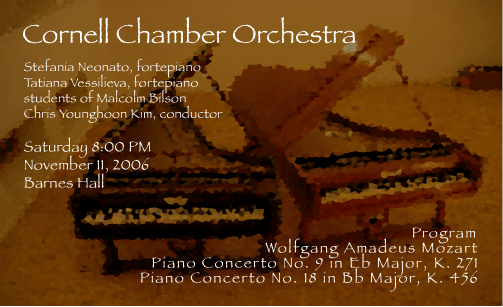
Here is the poster from our November 11th concert by the Chamber Orchestra featuring two concertos in our Semester long Mozart concerto project with Malcolm Bilson.
Our soloists were fanatastic. They were Stefania Neonato on K. 456, concerto No. 18 in Bb Major. and Tatiana Vassilieva on K. 271, concerto No. 9 in Eb Major.
Here are their bios;
Tatiana Vassilieva, a native of St. Petersburg, Russia, is a dual Master’s degree candidate at the Eastman School of Music in Rochester, NY, studying piano performance with Nelita True and collaborative piano with Jean Barr. She has recently completed her Bachelor’s degree in piano performance at Eastman with Nelita True and Fernando Laires. As a soloist, Ms. Vassilieva has appeared with the Rochester Philharmonic, Eastern Festival, and the Greece Symphony orchestras. Other performance highlights include a “Rising Stars Recital” at the Eastman Young Artist International Piano Competition and the Eastern Music Festival concert at the Kennedy Center. In addition to being an active solo pianist, Ms. Vassilieva is also a skilled accompanist and collaborates frequently with numerous instrumentalists and vocalists at Eastman. In the summer of 2006, Ms. Vassilieva attended the Collaborative Piano Program at the Music Academy of the West in Santa Barbara, CA, where she studied with Anne Epperson and Jonathan Feldman.
Born in Trento, Italy, Stefania Neonato graduated at her home town Conservatory and earned a Master in Fortepiano Performance Practice at the International Piano Academy (Imola, Bologna). After a BA degree in Foreign Languages and Literatures at the University of Trento, she’s currently a doctoral candidate at Cornell University in the Historical Performance Practice program under Malcolm Bilson. Winner of many National Piano Competitions, she collected gratifying awards at International Contests; she played in the most important Italian cities (Milan, Rome, Florence, Bologna, Brescia, Venice, Padua, Bolzano, Cremona) and in several foreign centres (Paris, Salzburg, Miami, Miskolc, Dortmund), both as a soloist and with orchestras. She attended many master-classes around the world (among them at the Mozarteum in Salzburg) and was recipient of scholarships from the Interlochen Arts Camp (Michigan) and from the School of Music of Miami University. She studied with Riccardo Zadra, Leonid Margarius and Aldo Ciccolini but her interest in historical instruments has been arisen by the meeting with the pianist Alexander Lonquich whom she followed in many seminars on the collections of the Accademia Bartolomeo Cristofori in Florence, Fondazione Giulini in Briosco-Milan, Accademia in Imola-Bologna). In 2004 she was invited to give a seminar on historical performance practice at Trento Conservatory and in 2005 her first recording was released: it features Mozart, Beethoven and Dussek on a 1780 Viennese fortepiano.
panoramic photo

Thanks to Maria Aridgides(mother of Daniel Aridgides, our former horn player who graduated) for this beautiful photo. Photo was taken during the performance of Mahler's First Symphony last season at Ford Hall.
She writes, "In particular I have a very unique photo of the whole orchestra playing that encompasses everybody from left to right. The photo was photostiched from five or six shots. It is approx. 9" high by 48"wide but could be increased or decreased."
The link is to her website.
Thursday, November 09, 2006
Malcolm Bilson receives honors

We are indeed quite lucky to be able to work so closely with Malcolm Bilson this semester on the Mozart Piano concerto project. November 11th concert will feature two more of his doctoral students. Stefania Neonato and Tatiana Vessilieva.
Orchestra fund raiser

Sorry for the long time since the last post. A lot of events. Just a short run down of events;
October 19 Midday Music with Guest artist Andrew Eng
October 21 First Family Weekend concert
October 26 Inauguration of Bailey Hall concert
November 4 Berlin tour fund raiser Lunch at Lincoln
November 11 Cornell Chamber Orchestra concert
Also we are in the middle of a violin professor search.
We had our first finalist Joseph Lin audition. He played a recital and gave a lecture and taught three sessions.(two violinists and a piano trio).
Here is the poster for the fundraiser.
Tuesday, October 10, 2006
Guest soloist Andrew Eng

Andrew Eng will be joining members of CSO in a performance of Astor Piazzolla's Winter and Spring from Seasons on the October 19th Midday concert. Here is his biography.
Andrew Eng, violinist and violist has gained a versatile reputation
playing such diverse genres as Baroque, Classical, Tango, Jazz and
Contemporary music. Eng’s playing has been noted as “intense and
powerfully emotional”(Classical New Jersey) and by The New Jersey Star
Ledger, as having an “instinct for the emotional pulse of the line”.
A founding member of the Kalistos Chamber Orchestra of Boston, and the
Symphony in the Barn of Ontario, Mr. Eng also plays as the principal
violinist for MASS Tango, the Chagall-Boston String Quartet and as a
member of the Found Objects Jazz String Trio of Boston. He is a frequent
Guest Artist on the Lyrica Boston Chamber Music Series since its’
inception in 2003.
Festival appearances include Spoleto, Orford, Domaine Forget,
LyricaFest, Killington and the Quartet Program at Bucknell University.
Eng recently collaborated as a soloist with Elmar Oliveira and the
Lyrica Chamber Orchestra, in chamber music with Eugene Drucker, Terry
King, Victor Rosenbaum, Joseph Robinson and jazz improvisation with
George Garzone, Diane Monroe, and Peter Cassino.
Presently he is a featured soloist in the newly released Lyrica Live cd in
performances of Bach’s A minor Concerto and short pieces of Bloch with
the Lyrica Chamber Orchestra. Mr. Eng has been heard on New Hampshire,
Vermont and Canadian Public radio.
This season, as Guest Concertmaster of the Indian Hill Orchestra, Eng
performed Rimsky- Korsakow’s Capriccio Espanole and was subsequently
invited to serve as a soloist for the New Bedford Symphony.
This summer, Eng joins the faculty of LyricaFest, a summer music
festival in New Jersey, which represents students from virtually every
major music school in The United States.
In 1998, Andrew received his A.R.C.T. Performer’s Certificate from the
Royal Conservatory in Toronto, Canada, and then in 2003 and 2005
respectively received his Undergraduate Diploma and Master of Music at
the Longy School of Music as a student of Laura Bossert and Peter
Cassino. Eng was honored with the Patricia Sherman Award, the highest
honor given to a member of the graduating class.
Pictures from the October 1st concert


Here are some pictures thanks to Stephanie Chu.
If you have pictures of the concert send them on to our webmaster Thomas Weber (tfw4)
Thursday, October 05, 2006
poster for October 19 is ready

The poster for the October 19th midday concert is ready.
The program will feature;
Astor Piazzolla Winter and Spring from the Seasons
with guest violinist Andrew Eng
Jean Sibelius Swan of Tuonela
with Anna Herforth, English Horn
W.A. Mozart Piano concerto No. 12 in A Major, K. 414
with Sezi Seskir (student of Malcolm Bilson)
Wednesday, October 04, 2006
Article on Shostakovich
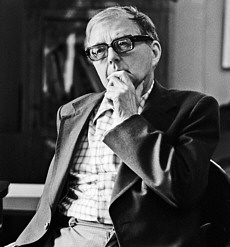
Here is an article on Shostakovich. As we start our rehearsal process on Shostakovich's first symphony if you have an article you would like the orchestra to read, please email me. We are alos looking for guest bloggers.
Thursday, September 28, 2006
Article in the Ithaca Journal's ticket

Thank you for our long time supporter Daphne Chu for alerting me about the Ithaca Journal article.
It is great to have local press support for this concert. We should also thank Loralyn Light, our concert manager for getting all the press releases out. Also Thanks to Robert Barker for the photograph.
Notes on Divertimento

Here are notes on the Bernstein Divertimento by Symphony Pianist and co president Daniel Jones.
Also a picture of a guy in a turkey suit trotting.
Leonard Bernstein has long been closely associated with the city of New York, New York, where he made his celebrated debut with the New York Philharmonic, and later went on to serve as music director of that orchestra for twelve years. His music, too, reflects that association: the 1944 musical “On The Town” recounts the adventures of three sailors on shore leave in New York, and the city also provides the backdrop for his most famous musical, “West Side Story.” Sometimes overlooked, however, is Bernstein’s equally meaningful association with New York’s sometime rival to the north, the city of Boston. Bernstein was born in Lawrence, Massachusetts, outside of Boston, and grew up in the Boston area. As a child, his father took him to concerts of the Boston Symphony Orchestra at Symphony Hall, planting the seeds of a long relationship with that orchestra. This relationship deepened in 1940, when Bernstein spent the summer at Tanglewood, the BSO’s summer home in Lenox, MA. There, BSO music director Serge Koussevitzky served as mentor and teacher to the young Bernstein, and later in his life Bernstein followed Koussevitzky’s example by returning as head of the orchestra and conducting programs at Tanglewood. Indeed, Bernstein’s final public performance was a concert in which he led the BSO at Tanglewood in August 1990.
Given his deeply rooted connection with the BSO and the city of Boston, it is no surprise that the BSO commissioned Bernstein to write a piece for the orchestra’s centennial in 1980. The result was the Divertimento for Orchestra, premiered under Seiji Ozawa on September 15, 1980. As its title suggest, the Divertimento is a light-hearted, high-spirited, witty piece, full of musical allusions and in-jokes with orchestra members. The first movement, Sonnets and Tuckets, is a boisterous exploration of the possibilities of the work’s underlying motive, an alternation between the notes B and C. The “B,” of course, stands for “Boston,” while the “C” stands for “Centennial.” Along the way, he throws in references to Strauss’s Till Eulenspiegel, and at one point gives the clarinets the famous trumpet lick from Stravinsky’s Petrouchka. The movement comes to an emphatic (albeit dissonant) close with the full orchestra blaring simultaneous B’s and C’s. Waltz, the second movement, is of an entirely different character: restrained, lilting, and poignant, it keeps the string players happy with some lovely writing. Of course, the Divertimento being what it is, Bernstein casts it in the offbeat meter of 7/8, instead of the usual 3/4.
While the Waltz was written primarily with strings in mind, the Mazurka provides the winds and particularly double reeds with their moment in the sun. Devotees of 19th century piano repertoire will recognize the three note descending motive lifted from Chopin, in another of the many allusions found throughout the work. It is worth noting that Bernstein’s highlighting of the various sections of the orchestra was very much intentional, and in many cases based on Bernstein’s personal relationship with the BSO players. When he wrote in a solo for a particular instrument, it wasn’t (for instance) for some anonymous oboe or horn player, but for a musician whom Bernstein knew personally, and whose personal traits he often had in mind when writing.
The Samba is a lively dance movement, reminiscent of some of the music from West Side Story, and the Turkey Trot is another dance movement, recalling a style popular in the early 1900s. The conductor Leonard Slatkin claims that “Turkey Trot” is the name of a street in Lenox, MA, the town in which Tanglewood is located. If so, the title is yet another of the many allusions and in-jokes sprinkled throughout the piece. However, independent research failed to confirm the existence of this road, so Slatkin’s claim may have to be regarded as apocryphal for now. Sphinxes is a satirical foray into the world of twelve-tone music, of which Bernstein was no enthusiast. The movement contains two twelve-tone rows before a perversely tonal cadence on A-flat major, with Bernstein getting the last laugh on the serialists. The Blues serves to highlight the brass section, and provides the principals with some nice opportunities to display their solo chops. Transferring the blues idiom to symphony orchestra always risks becoming a dull and inauthentic-sounding exercise, but here, Bernstein skillfully captures the color and spirit of the blues.
The final movement, In Memoriam and March: The BSO Forever, begins with a solemn introduction for flutes in memory of BSO members and conductors past. The boisterous music of the first movement soon returns, however, before the orchestra erupts into a full-blown, Sousa-esque march, amply seasoned (of course) with references to Sousa. The final chord brings the work full circle, with a resounding declaration of “B” and “C” simultaneously. – Notes by Daniel Jones
Magic flute notes

Here is program notes by Chamber Orchestra violist Dorian Bandy and a great picture of the set for Magic Flute by Karl Friedrich Schinkle which is in the Staatliche Museen, Berlin
Despite his poverty and diminishing health, Wolfgang Amadeus Mozart (1756-1791) remained prolific even during the last year of his life. Indeed, in the months immediately preceding his death he composed a piano concerto, a clarinet concerto, thirty-nine orchestral and chamber works, a Requiem mass, three cantatas and motets, and two operas. One of these, Die Zauberflöte (The Magic Flute), was completed on September 28 and premiered on September 30, 1791. Although the opera was a hit success, and played in Vienna for the next few years, its warm reception mattered little to Mozart, who died ten weeks after the initial performance.
Mozart’s long-time colleague, Emanuel Schikaneder (1741-1812), famed actor, poet, and singer, provided the story and text for Die Zauberflöte: The evil and tyrannical Queen of the Night employs Tamino, a prince, and Papageno, a bird catcher, to rescue her daughter Pamina from the evil sorcerer Sarastro. Upon entering Sarastro’s “Temple of Wisdom,” they discover the sorcerer’s benevolence, and agree to undergo extensive initiation rites (based on real Masonic rituals) so that they may join the Temple. Tamino succeeds and weds Pamina (much to the Queen’s chagrin); Papageno fails the initiation but still finds happiness with Papagena, his female counterpart. Annoyed at this collective rapture, the Queen tries to destroy Sarastro’s Temple, but to no avail: Sarastro vanquishes the Queen’s forces, and the four lovers continue to lead long and happy lives. (The magic flute itself plays an ironically small part in the opera—it appears in only two scenes and has little or no effect on the plot.)
The overture to Die Zauberflöte reflects many of the themes that Mozart and Schikaneder explore during the opera itself. The music begins slowly, with three majestic chords, reminiscent of those which herald Tamino’s entry into Sarastro’s Temple. The next section, a jovial fugato Allegro, introduces a melody in the second violins, which all of the strings successively imitate. (Here, the presence of a fugue, one of the most complex forms of composition, represents the wisdom Tamino hopes to attain in Sarastro’s Temple; the playful character of this fugue in particular resembles the lighthearted irreverence with which Papageno ignores the Temple’s initiation rites.) The strings continue to play fragments of the original melody while the winds carry a slightly more lyrical theme, possibly indicative of Papageno and Papagena’s innocent love affair. The music builds to a faux-finale, which is interrupted by a restatement of the same three chords that opened the overture. The Allegro theme then resumes, though this time with a much darker mood, a reminder of the Queen of the Night’s many attempts to prevent her daughter’s and Tamino’s happiness. As in the opera, however, the clouds soon lift, and give way to a triumphant and joyous climax. – Notes by Dorian Bandy
Program notes on Mozart by our soloist

Pianist Frédéric Lacroix has performed in the United States, Canada and Taiwan. He has most recently appeared with the Albany Symphony Orchestra, Cornell Chamber Orchestra, Ottawa Symphony Orchestra and Ensembre Fusions. He has also performed in programs of CBC Radio and NPR. While he also the privileged to premiere a number of works by American and Canadian composers, he devotes some time to his own compositions. Lacroix holds degrees from the University of Montreal and the University of Ottawa, where he studied with Marc Durand and Cynthia Floyd. He is currently a doctoral student at Cornell University, where he is studying performance practice with Malcolm Bilson.
Following his departure from Salzburg in 1781, Wolfgang Amadeus Mozart settled in Vienna and embarked on a series of successful business and artistic ventures, becoming a thriving freelance musician in an era dominated by a system of patronage. The early Vienna years were marked by the prodigious composition of keyboard concertos (there were six completed in 1784, the year of the composition of the keyboard concerto K.453), most of them destined for his own performance at subscription concerts and ‘academies’; the latter being well-attended ‘epic’ concerts which Mozart would organize to showcase himself as performer and composer. The Concerto in G major K.453 was composed for an ‘academie’ given by Mozart’s pupil, Barbara Ployer, on June 10, 1784. While most concertos up to 1784 were composed somewhat pragmatically in a ‘galant’ chamber music style and with allowances for a reduced orchestra in which the wind parts would be optional, Mozart shifted his ideals early that year to create concertos ‘which would be bound to make the performer sweat’. These concertos, starting with the keyboard concerto K.450 are increasingly symphonic in nature and contain significant wind parts, creating a true battle between soloist and orchestra.
Typical of Mozart’s G major, the concerto opens with music that expresses a somewhat naive happiness or contentment. This naiveté soon dissipates as the composer turns the wheel of his kaleidoscope and reveals within this happiness hues of comedy, tenderness, passion and uncertainty. The slow movement is remarkable for its departure from the home key of C major. At first, Mozart seemingly evokes an innocent tenderness, but his use of chromaticism and his far-reaching modulations generate some of his most passionate music. The last movement is composed in variation form, a genre popular with the audiences of the time, and ends with an extensive finale section. The dramatic rhetoric of this movement recalls the operatic discourse; in particular, either by its key or by some of its volubility, it anticipates The Magic Flute. The cadenzas used in today’s performance were composed by Mozart. – Notes by Frédéric Lacroix
Iraqi National Orchestra

Here is a moving report on the Iraqi national symphony.
A few excerpt from the article;
"The musicians are running out of things like reeds and strings, and few music stores remain open in Iraq, partly because militant Islamists have bombed several. Players must worry about offending fundamentalist militiamen and Islamist neighbors."
and
"This orchestra represents the real map of Iraq,” Mr. Nasser, 48, said as Mr. Baban lighted a cigarette. “This man is Kurdish, there’s another man there who’s Christian. This is a real national symphony. The ties among us are unbreakable.”
and
“My wife says: ‘Please don’t go. Life is very bad in Baghdad. There’s a lot of death in Baghdad,’ ” he said. “She tries to prevent me from coming, but I have to come. We can’t survive without music. It’s like oxygen.”
Not being able to rehearse in Bailey Hall during concert week is an inconvenience, but it is always good to remember what others who are less fortunate must go through to play music.
Monday, September 25, 2006
Poster for the October 1st concert

Here is the poster to our first concert of the year.
The concert will feature both the Chamber Orchestra and the Symphony Orchestra.
Program will include;
W.A. Mozart Piano Concerto no. 17 in G Major, K. 453
with Frederic Lacroix(Student of Malcolm Bilson), fortepiano
intermission
W.A. Mozart Magic Flute Overture
Leonard Bernstein Divertimento for Orchestra
and a surprise by both orchestras to close the concert.
Sunday, September 24, 2006
Gabriela Lena Frank with Silk Road Ensemble
Richard Dyer retires
I am especially inspired by the following statistic;
"Richard Dyer retired this month as classical music critic for The Boston Globe. Over 33 years, he wrote more than 12,000 articles about the arts for the Globe."
That is simply one person's contributions to arts in our society.
Thursday, September 21, 2006
Free Beehoven Fifth download

Philadelphia Orchestra has launched a music store. They are offering a free download of Beethoven's Fifth Symphony conducted Christoph Eschenbach.
Tuesday, September 19, 2006
New Architecture building
I have included the picture here. Construction is to start 2007 for about two years.
Monday, September 18, 2006
Orchestral news from around the globe
If you find an interesting article email it to me and I will post it.
Comparing New Opera Houses In Oslo And Toronto "Where Toronto opted to build an opera house that serves its purpose and nothing beyond, Norwegians understood that such a project must address more than the narrow spectrum of opera lovers. Oslo is also in the process of burying its elevated waterfront highway and its railway tracks. The objective is to reintegrate the old harbourlands back into the city, and transform it into a mixed-use neighbourhood where people live and work. What better way to launch the regeneration than by building an opera house?" Toronto Star 09/17/06
http://www.artsjournal.com/music/redir/20060917-66226.html
The Met In Times Square Metropolitan Opera "General Manager Peter Gelb said on Friday the September 25 opening night performance of Puccini's 'Madama Butterfly,' directed by filmmaker Anthony Minghella, would be beamed live to Times Square on a giant screen." Yahoo! (Reuters) 09/15/06
http://www.artsjournal.com/music/redir/20060917-66225.html
What If Mozart Had Lived? "Mozart’s death in 1791 was probably caused by streptococcal infection, renal failure, terminal bronchial pneumonia and a matrix of other illnesses, some dating from his childhood, when the Mozart family spent years touring Europe to show off the boy genius and, to a lesser extent, his sister. Imagine how different music history would have been had Mozart lived..." The New York Times 09/17/06
http://www.artsjournal.com/music/redir/20060917-66217.html
Indianapolis Symphony Gets A New Contract The Indianapolis Symphony has a new contract with its musicians. It provides for wage increases in each of its three years, a contast to the previous contract, which got significant compensation concessions from the players. Indianapolis Star 09/17/06
http://www.artsjournal.com/music/redir/20060917-66215.html
Classical Music, The Alt Intro New To classical music and looking for a good introduction? Sure there are the classics, the greats to recommend. But Andrew Adler has an alternative list to try to tempt you. Louisville Courier-Journal 09/17/06
http://www.artsjournal.com/music/redir/20060917-66212.html
Runnicles Out At SF Opera David Runnicles will leave his post as music director of San Francisco Opera after 14 years. "We came to the conclusion that it was in mutual best interest of Donald and the company to maintain our relationship, but to give each party the freedom to pursue other options." San Francisco Chronicle 09/16/06
http://www.artsjournal.com/music/redir/20060917-66211.html
From The Top To TV From the Top has become one of NPR’s more popular programs, and is "distributed to some 250 NPR outlets and boasts some 750,000 listeners." Now it will be on TV too, in a new series broadcast from Carnegie Hall. Musical America 09/15/06
http://www.artsjournal.com/music/redir/20060917-66196.html
Paris Finally Gets A Home Back For Classical Music "Paris had become one of the last major western capitals without a world-class space devoted exclusively to symphony concerts and a permanent home for its orchestras. But the French government yesterday set out to reclaim the city's classical music heritage, unveiling a €30m refurbishment of the Art Deco Salle Pleyel in Paris." The Guardian (UK) 09/14/06
http://www.artsjournal.com/music/redir/20060914-66161.html
Robertson Gets Extension In St. Louis The St. Louis Symphony has extended the contract of popular music director David Robertson through 2010. The orchestra has enjoyed a resurgence since Robertson took over in 2005, and the new contract continues the trend of American orchestras locking up their maestros long-term, once it becomes clear that the fit is a good one. St. Louis Post-Dispatch 09/14/06
http://www.artsjournal.com/music/redir/20060914-66147.html
UK To Allow Instruments Back On Board In response to public outcry (and what it says is a diminished threat level,) the UK's Department of Transport says it expects to relax restrictions on airline carry-on bags by next week. "The changes are likely to mean bulky items, including musical instruments, will be allowed as carry-on baggage." Some restrictions, including bans on liquids and gels, are likely to remain in place for the time being. The Guardian (UK) 09/14/06
http://www.artsjournal.com/music/redir/20060914-66146.html
Conducting Comp Has Its First Female Winner The Sir Georg Solti International Conductors' Competition is only four years old, but it has already become one of the top conducting awards in the world. This year, it's also making a bit of history, handing out its top prize to a woman for the first time: 31-year-old Shi-Yeon Sung of South Korea "receives a €15,000 prize and a concert date with the Frankfurt Museum Orchestra and the Frankfurt Radio Symphony." PlaybillArts 09/14/06
http://www.artsjournal.com/music/redir/20060914-66148.html
Lebrecht: Why Shouldn't Musicians Have To Fly Like The Rest Of Us? Norman Lebrecht is unconvinced by British musicians' protests over new airline carry-on restrictions. "If an exception were made for concert soloists, executives would demand to carry their laptops, nursing mothers their baby kits and would-be jihadis their special-mix drinks. It is not even in the musicians’ own interest to set them apart as a special case for that would separate them from the rest of the human race at a time when their greatest need, in classics and jazz, is to be seen as integral and essential to the emotions and rhythms of the modern world." La Scena Musicale 09/13/06
http://www.artsjournal.com/music/redir/20060913-66139.html
Indianapolis International Violin Competition Finalists Finalists include musicians from South Korea, Italy, Bulgaria, the Netherlands, the US and Germany. would be the "survivors." They're competing for $250,000 in prizes. Indianapolis Star 09/13/06
http://www.artsjournal.com/music/redir/20060913-66132.html
Chicago Concertmaster To Retire After 48 years, the Chicago Symphony's long-time concertmaster is going to retire. "Samuel Magad made his debut with the CSO at 11 as the winner of the CSO youth auditions. He joined the first violin section in 1958 under music director Fritz Reiner and was named assistant concertmaster in 1966. Georg Solti appointed him concertmaster in 1972." Chicago Tribune 09/13/06
http://www.artsjournal.com/music/redir/20060913-66128.html
Birmingham Orchestra Launches Podcast The City of Birmingham Orchestra is launching a monthly podcast. "Members of the public will be invited to review recent concerts, and each recording will aim to explain how the musicians work together. Each free podcast can be downloaded through the City of Birmingham Symphony Orchestra's website." BBC 09/12/06
http://www.artsjournal.com/music/redir/20060912-66121.html
iTunes' Classical Top Ten Classical music sells on iTunes in greater numbers than in CD stores. But what are the most popular downloads? The list is revealing, writes Marc Geelhoed. Slate 09/12/06
http://www.artsjournal.com/music/redir/20060912-66120.html
Baltimore Symphony Contract Talks Going Well? "Both sides negotiating a new contract for Baltimore Symphony Orchestra musicians have maintained a media blackout, but, with the current contract set to expire Saturday night after the annual BSO gala, there are a few favorable signs - and also potential concerns. ... As the orchestra's management aims to balance a budget after a string of annual deficits, negotiating points may include the orchestra's size and the length of its season - factors that can affect the BSO's reputation and ability to attract and retain talent." Baltimore Sun 09/12/06
http://www.artsjournal.com/music/redir/20060912-66110.html
Paris' Salle Pleyel Reopening After four years of renovation, Paris' Salle Pleyel reopens this week. The theatre is the Carnegie Hall of Paris. "The acoustics used to be a weakness of the Salle Pleyel. To improve them, architect Francois Ceria and Artec Consultants Inc., the acclaimed New York sound gurus, have encircled the platform with a wooden wall and added four narrow side balconies and a number of rows behind the orchestra, replacing the old Cavaille-Coll organ with a human reflector." Bloomberg.com 09/11/06
http://www.artsjournal.com/music/redir/20060911-66102.html
Claim: New UK Airline Carry-on Restrictions Killing Musical Life "Restrictions on hand luggage, intended to reduce the volume of baggage going through cabin security checks, have had a devastating impact on performers. Musicians who were used to stowing their Stradivarius in the cabin fear that irreplaceable instruments will be smashed by a careless baggage handler or wrecked by freezing temperatures in the hold. Instead, they are cancelling concerts or enduring exhausting train journeys." The Guardian (UK) 09/11/06
http://www.artsjournal.com/music/redir/20060911-66096.html
Thursday, September 14, 2006
Tuesday, September 05, 2006
Classical music news roundup
Compleat Mozart For Pennies On The Disk A new set of 170 CDs contains the complete music of Mozart. It costs about 70 cents per disk. "The complete recorded works of composers are nothing new, but this issue is rare for its low cost and popularity, at least in Europe. And there is something compelling about its compactness: your fingers can walk through Mozart�s entire output in a few minutes." The New York Times 09/04/06
http://www.artsjournal.com/music/redir/20060904-65950.html
The UK's Top 10 Orchestras - A List Richard Morrison makes a list, ranking Britain's major orchestras. At the top? Halle... The Times (UK) 08/31/06
http://www.artsjournal.com/music/redir/20060831-65934.html
Two Bach Manuscripts Discovered The earliest-known manuscripts to be written by JS Bach have been discovered in a fire-damaged library. "The two manuscripts date from around 1700 and contain copies Bach made of organ music composed by Dietrich Buxtehude and Johann Adam Reinken. Researchers found the documents in the archives of the Duchess Anna Amalia library in Weimar, where a previously unknown aria by Bach was discovered last year." Yahoo! (AP) 08/31/06
http://www.artsjournal.com/music/redir/20060831-65930.html
Can The World Get Excited About A Haydn Birthday? The world has been awash in Mozart this year. Three years from now it's a major Haydn birthday. "While just about everyone alive has been exposed to Mozart if only on a ring-tone or a lonely bus station, you could play Haydn seek all day long on Oxford Street without finding a single shopper who can name one of his works or whistle a theme. In the Classic FM Hall of Fame, that rough guide to middlebrow taste, Haydn does not rank at all in the top 100 and even at the BBC Proms he gets just three nods in eight long weeks. How, demand the marketing men, do we sell something so resolutely obscure?" La Scena Musicale 08/30/06
http://www.artsjournal.com/music/redir/20060831-65928.html
Why Seattle's Musicians Are Leaving "Over the past couple of years, significant members of Seattle's music community have been drifting south, drawn by Portland's inexpensive cost of living and vibrant creative community. Scott McCaughey, Michael Maker, Chris Walla, Tucker Martine, and Laura Veirs are my neighbors. That you might not have noticed can be partially attributed to our somewhat nomadic lifestyles, but it also speaks volumes about how disconnected the once-cohesive Seattle music scene has felt lately. In a lot of respects, Portland has become Seattle's hot new neighborhood." The Stranger 08/31/06
http://www.artsjournal.com/music/redir/20060831-65926.html
Early Music Heaven The Utrecht Early Music Festival offers 100 concerts in a week. "About 55,000 people will attend. More than half of the concerts are free; most of the rest have ticket prices around 15 euros, or a little under $20. About 25 concerts are broadcast live. Seen from the United States, where classical radio is courting extinction, you wonder whether this is utopia." Philadelphia Inquirer 08/31/06
http://www.artsjournal.com/music/redir/20060831-65921.html
Orchestra On The Move (Literally) How do you move a large symphony orchestra around Europe? It's a ballet of trunks and containers. "The payload has its own itinerary, flying from Toronto to Rome to Athens to begin the tour, while the musicians flew through Frankfurt. The cargo has its own seating arrangement, with each case holding multiple instruments stacked like a Tetris game on pallets loaded into the plane. It also has its own strict program -- an important customs document called the carnet that is as strictly adhered to as any concert personnel chart." Pittsburgh Post-Gazette 08/30/06
http://www.artsjournal.com/music/redir/20060830-65899.html