Tuesday, May 09, 2006

Our own Sean Shepherd's tales in Minnesota


Our very own former Orchestra TA and Grad student/bassonist is featured in the American Music center to blog his experience with the Minnesota Orchestra reading.
Check it out.

Monday, May 08, 2006

2006-2007 season plan

Here is a tentative schedule for the 06-07 season.
The rehearsal times for the orchestras are as follows;
Cornell Symphony Orchestra
Monday 630-815 pm in Bailey Hall
Wednesday 700-900 pm in B20 of Lincoln Hall

Cornell Chamber Orchestra
Tuesday 445-615 pm in Barnes Hall
Thursday 445-645 pm in Barnes Hall

The concert dates for 2006-2007 season are
Cornell Symphony Orchestra
Sunday 3 pm, October 1, 2006 in Bailey Hall [joint concert with CCO]
Saturday 8 pm, October 21, 2006 First Family Weekend concert in Bailey Hall
Thursday 8 pm, October 26, 2006 Inauguration concert for Bailey Hall
Sunday 3 pm, December 3, 2006 in Bailey Hall
January 9-16, 2007 Tour to Berlin Germany
Sunday 3 pm, March 4, 2007 in Bailey Hall, with Cornell Concerto Winner
Sunday 3 pm, April 29, 2007 in Bailey Hall

Cornell Chamber Orchestra
Sunday 3 pm, October 1, 2006 in Bailey Hall [joint concert with CSO]
Thursday 1230 pm, October 19, 2006 Midday concert in B20
Saturday 8 pm, November 11, 2006 in Barnes Hall
Sunday 3 pm, November 12, 2006 concert at Smith College with Malcolm Bilson
Friday 8 pm, December 1, 2006 concert in Rochester, NY
Sunday 3 pm, February 25, 2007 in Barnes Hall, with Annette Richards and David Yearsley and Richard Faria
Monday 8 pm, March 12, 2007 in Barnes Hall, Music of Gideon Klein with Brave New Works and guests
Sunday 3 pm, April 22, 2007 in Barnes Hall, with Gabriela and Roberto Diaz

Dates and venues are subject to change. For the latest info please visit our websites;
CSO
http://www.arts.cornell.edu/orchestra
CCO
http://www.arts.cornell.edu/orchestra/ccohome.htm
Orchestra Blog
http://www.cornell-orchestra.blogspot.com/
Friday, May 05, 2006

Kristin Kuster gets a NYtimes review

Kristin Kuster was a guest composer of Ensemble X during last year's season.
She received a favorable review from NY times regarding her recent performance with the ACO.

"Kristin Kuster's "Myrrha" (2006), for orchestra and chamber chorus (the ACO Singers) drew on Ovid's story of a woman who lusted after her father (the result of being cursed by Aphrodite) and was transformed by the gods into a tree. Stravinsky's shadow is caught hovering over more than a few passages, both in savage, bright-edged chords in the "Sacre" style, and in the ritualistic accent he used in works like "Oedipus Rex." But Ms. Kuster's choral writing has an invitingly tart edge, and she writes commandingly for the orchestra." Allan Kozinn of the New York times.

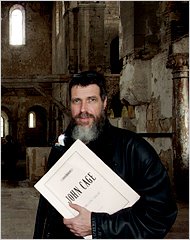
639 year long performance


The concert CSO will present on Sunday will be the longest this year, with Johannes Brahms' Nanie and Mahler's Symphony No. 1. However, it will be a blink of an eye compared to a performance that is in progress currently and will continue for the next 639 years of a piece by John Cage.
"In fact, you have about six more centuries to hear developments in the work being performed, a version of a composition by John Cage called "As Slow as Possible." A group of musicians and town boosters has given the title a ridiculously extreme interpretation, by stretching the performance to 639 years."

Thursday, May 04, 2006

out of the ordinary harpist


I ran across this on of all places Apple.com

Monday, May 01, 2006

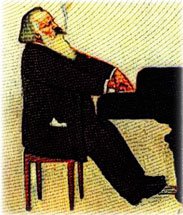
notes on Brahms by Kristin


Here are program notes on Brahms by Orchestra TA, Kristin Kane.
In July 1880 Brahms wrote to his friend Elisabet von Herzogenberg:

"I am quite willing to write motets are anything else for chorus (I am heartily sick of anything else!); but won't you try to find me some words? One can't have them made to order unless one begins before good reading has spoilt one. They are not heathenish enough for me in the Bible. I have bought the Koran but can find nothing there either."

Later that year he settled on an appropriately 'heathenish' text by Schiller – a meditation on the transience of life, which even the beautiful can not escape. As is often the case in Brahms' meditations on death, a glimmer of hope is offered – in the case of Nänie it is not in divine comfort (as in the German Requiem), but in the glory of memory, that consolation is found.

Brahms dedicated his Nänie (Threnody) to Henriette Feuerbach, the mother of the late painter Anselm Feuerbach, whose work Brahms had much admired. But the choice of text was surely suggested to him by the setting of Schiller's poem by Hermann Goetz, which had been premiered in Vienna earlier that year. Scholars have since noted a number of similarities between Brahms' setting and Goetz's, suggesting that the musical allusions Brahms' Nänie may have been conceived in homage to the recently deceased composer. Malcolm MacDonald has suggested that Brahms' Threnody might thus be heard as a 'double-memorial' for his two esteemed colleagues.

Kristin Kane

Friday, April 28, 2006

CSO photo page updated

Also updated is the Photo page for CSO.
Includes back stage look at Bailey Hall and fixed the problem with photos from March 11. If you have photos for the website send them on to me.

CCO photo pages update

Here is a link to the updated CCO photo page. Includes pictures from the March 5 and April 15 concert. If you have pictures from the John Cleese you'd like to submit for the website, please send them to me.

Thursday, April 27, 2006

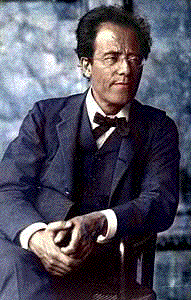
notes for Mahler from Bob


Here are Program notes for the Mahler for the May 7th concert by orchestra percussionist and Symphony Board president Bob Whalen.
Mahler was recognized as an extraordinary talent at the piano upon entering the Vienna Conservatory when he was fifteen. He was given influential positions as a conductor in his adult life, and gained the support of fellow composers, including Arnold Schönberg, who proclaimed Mahler a saint. Yet his symphonies rarely won wide favor with critics or audiences until well after his death – first, with Bruno Walter and Dmitri Mitropoulos, and later with Leonard Bernstein. Today, Mahler’s symphonies are staples in the orchestral repertoire and are heard in performance all over the world.
A trademark of Mahler's symphonic style is the use of quotation, mostly of Mahler's own songs. Yet none of his ten (or eleven, if you count Das Lied von der Erde) relies on quotation as much as his First Symphony. The “Titan,” as Mahler’s First Symphony is popularly known, opened to cool audiences and disparaging critics on November 20th, 1889 as a five-movement symphonic poem. The attacks from critics came in large part in response to his revolutionary orchestrations. The concept of using a “vulgar town band” playing klezmer-style music in turn-of-the-century Berlin drew many appalled reviews, souring what might otherwise have been a triumphant premiere.
Lost on the audience accustomed to Romantic extroversion were the ironies pervading the work, resulting from the use of pervasive quotation. His quotations begin in the first movement of the First Symphony, drawing from his song cycle Lieder eines fahrenden Gessellen (Songs of a Wayfarer). Another song from his Lieder und Gesänge provides the basis for the second movement. Originally titled Maitanz im Grünen, the second movement owes a substantial amount to Hans und Grethe.
The third movement, infamous at its time for the parody of “Brüder Martin” (Frère Jacques) and for the use of klezmer-style interpolations with the instruction to play Mit Parodie (Parodically), is yet another field in which Mahler sows tunes from Lieder eines fahrenden Gesellen. In this movement, Mahler quotes material from the final song from his cycle, Die zwei blauen Augen von meinem Schatz.
The final case of Mahler’s self-quotation in the First Symphony is from his song, Hochzeitsstück. However, he also references, And He Shall Reign Forever and Ever from the Hallelujah Chorus of Handel's Messiah. The Messiah quotation, though not taken from Mahler's own output, is significant because it is a major-mode version of the minor descending melodic fourths statement in the woodwinds that begins the symphony, lending a cyclical structural unity to the work.

Wednesday, April 26, 2006

violin search schedule

In the next few weeks we will be conducting a violin professor search for 2006-2007 academic year.
There are three final candidates and here is the audition schedule. I encourage all string players to attend as many sessions as you can.

Sunday April 30, in ROOM B21:
1:30 pm mini-recital and masterclass by Benjamin Sung (all auditions, 90 minutes max)

Monday, May 8th in ROOM B-20:
12 noon, mini-recital and masterclass by Shem Guibbory.
5 p.m., mini-recital and masterclass by Stephen Miahky.

Thanks to Miri Yampolsky and Alvin Lee for agreeing to play the Beethoven C Minor
sonata in the masterclasses.

Tuesday, April 25, 2006

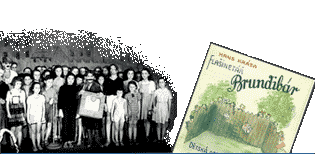
Music of Remembrance


A worthy organization in the Seattle area exploring music of the persecuted and also commissioning new music.
Music of Remembrance is a Seattle-based nonprofit organization dedicated to remembering Holocaust musicians and their art through musical performances, educational activities, musical recordings, and commissions of new works.

Former visiting professor of music Yehudi Wyner wins Pulitzer


So last year was Steven Stucky winning the Pulitzer with his Second Concerto and this year it is Yehudi Wyner a former visiting lecturer winning the Pulitzer for his piano concerto "Chiavi in mano," a piece commissioned by the Boston Symphony Orchestra (BSO) and premiered by soloist Robert Levin and the BSO in February 2005. Here are a couple more links

http://www.npr.org/templates/story/story.php?storyId=5347962

Another John Cleese picture on Cornell Chronicle

Here is a link to the April 20 the edition of the Cornell Chronicle. It features on the front page a very nice picture of John Cleese during the dress rehearsal in State theater on the 15th of April narrating Peter and the Wolf. Picture is by Robert Barker who has photographed many musical events for us in the past.

Terezin Article

Here is an amazing article about life in Terezin.
"They were really the next generation of leading figures in classical music...," says Mark Ludwig, who runs the Terezin Chamber Music Foundation in Boston, which ensures that the works from the camp are still performed. "And they disappear off the face of the Earth."

Week of full concerts in Ithaca

Here are some concerts in our area.

Tuesday 4/25 8 pm in Barnes Hall
Student Chamber Music Recital. [Support your fellow musicians]

Wenesday 4/26 - Saturday various venues
15TH ANNUAL JAZZ FESTIVAL; Paul Merrill, director. Concert I: Bissett and Trommer Jazz Combos

Wednesday 4/26 - 8 pm State Theatre
Cornell Concert Series: Roby Lakatos Ensemble. Features Hungarian classical/gypsy/jazz violin with piano, guitar, bass, and cimbalom. Admission: General $28, 23, 18; Students $18, 15, 12.

Thursday 4/27 815 pm Ford Hall
ITHACA WIND ENSEMBLE 27th APRIL 2006
Conductor Timothy Reynish
Secret Rites (Japan) Akira Miyoshi
Reflections on a 16th Century Tune (UK) Richard Rodney Bennett
Conductor Andrew Krus
L’Homme Armé: Variations (New Zealand) Christopher Marshall
intermission
Conductor Timothy Reynish
Resonance (New Zealand)World Premiere Christopher Marshall
Dances from Crete (UK) Adam Gorb
Marsch (Luxembourg) Marcel Wengler

Time: 8:15 pm
Venue: Ford Hall, Ithaca
Both 'L'homme armé: Variations for Wind Ensemble' and 'Resoncance' were
commissioned by Timothy and Hilary Reynish in memory of their son
William.

Monday, April 24, 2006

Some sound advice

This is from a youth orchestra hand book on;

How To Get The Most From Your CYSO Experience
Come to rehearsals prepared physically and mentally.
You will gain the most from CYSO if prior to rehearsals you;
Have had enough rest
Have eaten properly
Have studied your parts with your teacher
Have practiced your assignments between rehearsals
Use practice time efficiently.
Maximize the effect of your practice with good habits;
Schedule a time during the day when your are not pressured to do other tasks, like homework
Work with your teacher to highlight areas that you need to concentrate on
Be consistent in your practice time. How long you practice is as important as what you practice.
Be focused
Set goals and keep notes on your progress
Use a metronome
Be open to the music at rehearsal.
Come to rehearsal to ‘experience’ the music not just play the notes;
Listen to how your part relates and fits to the other sections
Play as a member of your section and a member of the whole ensemble
Learn what the music is about and what the composer is saying
Think about how the music make you feel and why

Do you use these important techniques?
These techniques are just as important to a beginner as they are to a professional;
Breathe, especially before each phase and allow the music to flow from you
Sing the music to hear exactly how it sounds, before playing it. With your instrument duplicate
what you hear in your mind.
Subdivide the beats and keep the beat even and accurate
Watch the conductor, your section leader and concertmaster. Be aware of cues that give you
dynamics, vibrato, bow speed and placement. Cues are essential to each entrance, tempo change,
accents, and cutoff!
Listen to where you are in the ensemble. Balance your part in the ensemble and your intonation
Sustain your sound in intensity, intonation and quality. This is a skill that takes work to develop,
but one that distinguishes great players. No other player or section can carry your part. You
must commit to follow through.
Feel the music. The ultimate goal of music is the expression of the music through you and your
instrument. Tell the story of the music, your feelings about the music, and share that feeling with
your audience

The Gospel of New Music, According to the Violinist Midori

"It excites me that I live in the same world as these composers," she said. "We're breathing the same air. The things I'm experiencing are things they're expressing through their music." - Midori
Excellent article about what Midori has been doing lately to promote new music.

Watch out for the lightning conductor

Young conductor signed for City of Gothenburg orchestra.
A new Simon Rattle?

Soloist's violin mishap upstages CSO concert

Joshua Bell breaks his violin while performin Tchaikovsky but recovers to finish his performance.

Airline played instrumental role in orchestral woes

Here is a story about how a group of high school students traveling on Northwest had a disaster with their instruments.
Yikes!